← All articles
GEO October 2026: what we see happening in AI models as a GEO agency
22 October 2026 · · 8 min read
Wildbos is a GEO agency. Since July we have been putting buying questions to ChatGPT, Gemini, Claude, Perplexity and four other AI assistants, and we store every answer together with its sources. By now that is 58,272 answers. On top of that, we log every visit from an AI crawler on two websites.
This monthly report is not about how brands score. It is about the models themselves. Where do they get their information, how do they differ from each other, and how often do their crawlers come by?
In short
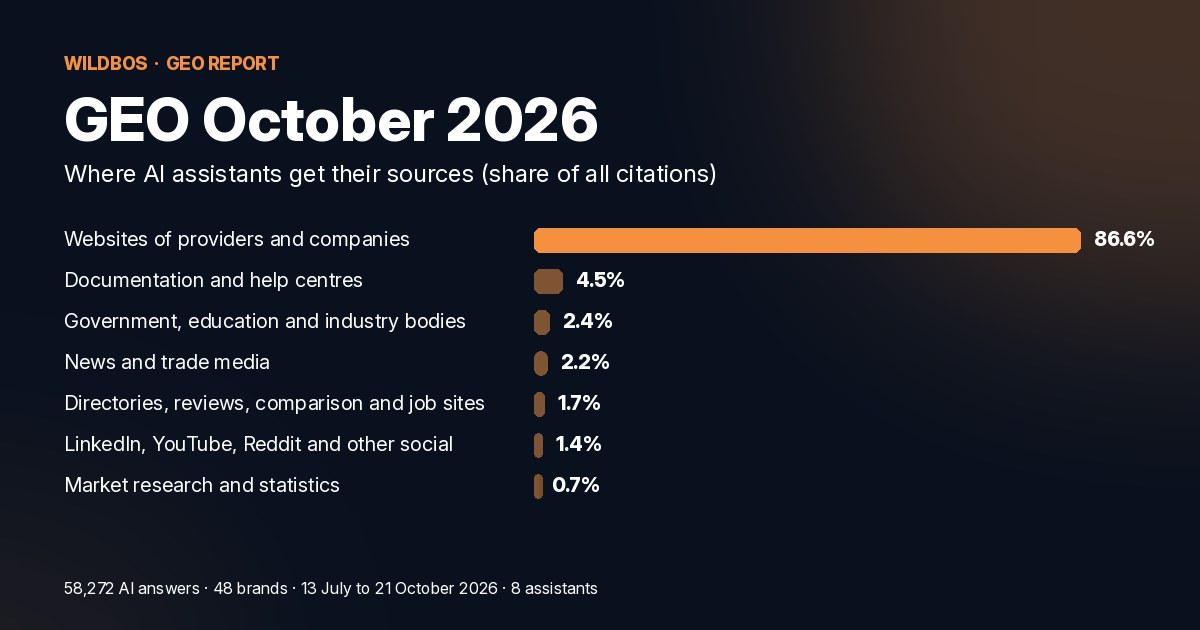
AI assistants build their answers mainly from the websites of the companies the question is about. Of the 403,692 citations in our measurements, 86.6% went to websites of providers and companies.
| Source type | Share of citations |
|---|---|
| Websites of providers and companies | 86.6% |
| Documentation and help centres | 4.5% |
| Government, education and industry bodies | 2.4% |
| News and trade media | 2.2% |
| Directories, reviews and comparison sites | 1.7% |
| LinkedIn, YouTube, Reddit and other social | 1.4% |
| Wikipedia | 0.3% |
The distribution is skewed. The top 1% of the 27,786 domains received 41.2% of all citations. Whoever is the known source in a sector gets picked again and again. For a GEO agency that means a company's own website is the most important place to work, not a list of outside platforms.
In every sector, 8 to 10 of the 10 most cited domains are websites of providers. What differs is the second source and the language.
| Sector | Providers | Largest other type | .nl domains |
|---|---|---|---|
| Software and SaaS | 83.8% | Documentation and help centres, 7.8% | 7.7% |
| Personal injury and legal | 88.9% | Government and professional bodies, 4.6% | 86.0% |
| Marketing, sales and AI services | 92.7% | News and trade media, 2.2% | 32.6% |
| Training, coaching and education | 89.1% | Directories and comparison sites, 4.7% | 75.6% |
| Industry, logistics and energy | 88.4% | Market research and statistics, 4.7% | 9.1% |
In software, AI likes to answer with the manual or help centre of a platform. In training and coaching, comparison sites weigh more heavily; Springest was the largest public platform there. In industry, AI cites market research reports remarkably often. Personal injury is the most concentrated: the ten largest domains together received 22.2% of citations, almost all of them Dutch-language.
Marketing and AI services is the opposite: 6,146 different domains, and the top 10 gets only 8.6%. Nobody has become the default source there yet.
The same question gives different sources per assistant. For a fair comparison, this only counts the four brands we have measured on all eight assistants since 31 August.
| Assistant | Sources per answer | .nl source on Dutch question | Same sources as last time |
|---|---|---|---|
| Perplexity | 16.1 | 37.0% | 44.0% |
| Grok | 12.4 | 29.1% | 33.5% |
| Claude | 5.4 | 43.1% | 31.1% |
| ChatGPT | 5.3 | 52.1% | 38.3% |
| Mistral | 5.3 | 50.2% | 53.8% |
| DeepSeek | 4.9 | 48.7% | 57.5% |
| Meta AI | 4.7 | 48.9% | 59.1% |
| Gemini | 4.5 | 47.1% | 59.8% |
Perplexity and Grok work with far more sources than the rest. Dutch questions do not always get Dutch sources: for Grok, 29.1% came from a .nl domain. And the sources change a lot. Ask Claude the same question again and on average 31.1% of the domains are the same as last time.
The assistants also share little with each other. Given the same question on the same day, two assistants shared on average 25.5% of their domains. 75.6% of the domains were used by only one assistant. A GEO agency that only measures ChatGPT sees just a small part of the picture.
AI companies fetch pages to train far more often than to answer a question. On two websites we counted 31,475 requests from AI crawlers between 18 September and 21 October: 69.4% to train, 21.8% to fill a search index and 8.8% to fetch a page live because someone was asking something at that moment.
| Bot | Purpose | Per site per day | Back after |
|---|---|---|---|
| Meta-ExternalAgent | training | 217.3 | 2 days |
| PerplexityBot | indexing | 47.6 | 2 days |
| OAI-SearchBot (OpenAI) | indexing | 43.1 | 1 day |
| ClaudeBot (Anthropic) | training | 40.7 | 1 day |
| Amazonbot | training | 23.5 | 7 days |
| ChatGPT-User | live fetch | 13.3 | 1 day |
"Back after" is the median number of days until the same bot fetches the same page again. Meta is by far the busiest crawler. ChatGPT-User and Claude-User each fetch a page live about 13 times per site per day, the closest you get to "someone asked an assistant about this topic".
What the crawlers skip says something too. Both sites have an llms.txt, the file often recommended for telling AI what a site contains. In the whole period, not a single AI crawler requested it. robots.txt was fetched 1,677 times, and the sitemap regularly too. So if you want to help AI, first make sure robots.txt lets crawlers in and your sitemap is correct.
On its own, a model only knows what was in its training data up to its knowledge cutoff. For the versions we measure, that runs from October 2023 (GPT-4o mini) to February 2026 (GPT-5.6 Luna). Anything after that, an assistant has to look up live. So what is on your website today helps decide what AI says about you tomorrow.
Models are also replaced quickly. All ten versions we measure now have a successor, and there are usually about four months between two versions (our own calculation from the release dates on OpenRouter). What an assistant knows about you today is not fixed.
Across the internet, crawling is growing. According to Cloudflare, 52% of crawler requests in June 2026 were for AI training, up from 22% in spring 2025, while Google still delivers about 88% of referral traffic. Fastly found that Meta's crawler accounted for 60% of AI crawler traffic. That matches our own log.
And our market is not the American one. In a study by Ahrefs of 9,671,806 answers, 36.67% cited YouTube as a source and 8.81% Reddit. In our measurements, YouTube appeared in 1.0% of answers with sources and Reddit in 0.4%. A GEO agency that copies an American playbook puts its effort in the wrong places.
The numbers come from the Wildbos GEO platform. For each brand we put a fixed set of buying questions to up to eight AI assistants through their APIs, partly with web search, and store the answers with their source URLs. So we do not measure inside the apps themselves. The period runs from 13 July to 21 October 2026, with 48 brands, mostly Dutch B2B, partly with English questions. Sectors with too few answers are left out.
We sort sources into types with fixed rules per domain; anything that fits no rule counts as a provider. We never name provider websites. The crawler log comes from two Dutch business websites, 18 September to 21 October. As a GEO agency we publish this report every month with the same definitions.
A GEO agency makes sure AI assistants like ChatGPT, Gemini and Perplexity mention your company when a buyer asks a question. It starts with measuring which sources AI uses in your sector. Then comes the work on your website, content, mentions and reviews. A good GEO agency shows every month what changed.
In our measurements, mostly from the websites of providers themselves: 86.6% of 403,692 citations. Documentation and help centres, government and industry bodies, trade media and directories follow at a distance. Wikipedia accounted for 0.3%.
On the two websites we follow, Meta's crawler came by 217 times a day on average. The crawlers of OpenAI, Perplexity and Anthropic each came by 41 to 48 times a day and usually fetched the same page again within one or two days.
Want to know which sources AI uses in your sector? The free GEO scan shows it per assistant. Looking for a GEO agency that also does the work? That page explains how we do it.
Measure it for free and see per assistant which websites shape the answer.
Next steps
See which buying questions AI answers with your name, and which with a competitor's. Credits from €25, pay as you go.
Explore the platformNo time? We do the work. Your website, your content, press and reviews.
How done-for-you worksLearn how AI decides who it recommends. A hands-on training for marketers.
See the training